Did you know the Bible in it's original GREEK and HEBREW text never used the word 'Satan' as a proper noun. Hmmmmmm ... that changes things quite a bit.
In Hebrew, 'ha-satan' simply meant 'an accuser' or 'an opposer.' It was a title, given to ANYONE who opposed the will of God. For example, Peter was called a 'satan' when he opposed Jesus (Matthew 16:23).
The Latin Vulgate (the first official Bible) distorted this, turning 'satan' into a proper noun with a capital 'S' in the Latin and English translations (Wow!). HOW COME I NEVER LEARNED ABOUT THIS IN CHURCH ? This one distortion fed the idea of a single cosmic villain, rather than what the original writers meant: the adversarial "mindset" within humanity.
When you read the passages that refer to 'satan' in the original Koine Greek, here is what you find :
* Matthew 5:37: Instead of an 'evil one,' the Greek points to a 'bad condition of mankind.
* Matthew 6:13: Instead of delivering us from the 'evil one,' the Greek says 'rescue us away from the bad situation.
* Matthew 13:19: The 'wicked one' is described as a 'worthless person or disadvantageous circumstance.
* 2 Thessalonians 3:3: The Lord guards you from the malicious person.
* John 17:15: Jesus prays to keep them from the 'worthless or bad situation.
* 1 John 5:19: The world lies in the gush of misery.
* Ephesians 6:16: The fiery darts come from the worthless person.
* 1 John 2:13-14: You overcome the one bringing a gush of misery.
* 1 John 3:12: Cain was from the 'condition causing misery and hard labor,' not controlled by an external entity.
______________________
These passages sound more like toxic people in general, destructive attitudes, and oppressive systems, rather than a cosmic villain.
The real 'ha-satan' in scripture was always man's carnal nature ... the unrenewed mind (ego) that opposes the will of God. Mark 7:21 says that evil comes from the heart of man.
In the Garden, Adam and Eve's carnal minds were described as a 'talking snake' ... a metaphor for the adversary within. The Bible is full of such allegories, which modern Western evangelicals often interpret in literal fashion, leading to distortions.
Over the millennia, religion has twisted these original meanings, interpreting metaphors as literal entities and outward enemies.
The idea of a literal entity called Lucifer comes from one translation (the Living translation) which inserted the name 'Lucifer' into Isaiah 14. But that passage is simply describing how a proud king fell into the trap of his ego, losing sight of his true identity (something we can all relate to).
"Lucifer" is the false identity (ego) of the King of Babylon. (See Isaiah 14:4)
LET ME BE CLEAR ... 'demons' are not literal creatures, but distorted energies / internal patterns / mindsets that pull us away from our TRUE selves. They might show up as fear, pride, addiction, or confusion. The truth is, you and I create these distorted illusions ... but they are shadows created INTERNALLY through our own distortions ... then externalized and given power through one's own belief. - YES, as a creator, you are that powerful ... and as a creator, you can just as easily manifest energies of LOVE and LIGHT.
KEEP IN MIND ... The shadow is not REAL ... it is the absence of light.
That's why I'm not afraid of darkness. I'm only afraid of those who claim they have no darkness, and then rant and rave over the darkness they see in others.
For example: How many times have we seen Christian evangelists publicly rebuke prostitutes, fornicators, and homosexuals, only to find these same evangelists later exposed for the very things they condemned? The list of names is way too long.
The lesson here is: you will continue to attract everything you judge, until you no longer judge everything you attract.

Let's see what the the Greek Septuagint has to say about "demons" and "devils."
Isaiah 65:3 (Brenton Septuagint) 'This is the people that provokes me continually in my presence; they offer sacrifices in gardens, and burn incense on bricks to devils, WHICH DO NOT EXIST.'
Isaiah 65:3 (Oxford Septuagint) 'This is the people that provokes me continually in my presence; they offer sacrifices in gardens, and burn incense on bricks to demons, WHICH EXIST NOT.'
The Septuagint clearly states that these 'devils' or 'demons' are non-existent entities ... they are projections, not beings.
Now, let’s look at Psalm 96:5 across different translations :
* Tanakh 1917: 'For all the gods of the peoples are things of nought.'
* Young's Literal Translation: 'For all the gods of the peoples are nought...'
* Literal Standard Version: 'For all the gods of the peoples are nothing...'
...
These translations reflect the truth that pagan deities are symbolic projections, not independent entities.
But now, let's look at the same verse again through the Latin Vulgate and its derivatives :
...
* Psalm 96:5 (King James Version): 'For all the gods of the nations are IDOLS...'
* Psalm 96:5 (Catholic Public Domain Version): 'For all the gods of the Gentiles are DEMONS...'
* Psalm 96:5 (Douay-Rheims Bible): 'For all the gods of the Gentiles are DEVILS...'
Here, the Latin translators (influenced by Enochian mythology and pagan demonology) deliberately inverted the Septuagint’s clarity. They transformed 'nothing' into 'IDOLS' ... 'DEMONS' ... and 'DEVILS', thereby substantiating the existence of malevolent entities that the Greek text explicitly denied.
This linguistic inversion served a clear agenda: to reinforce fear-based control by externalizing evil and creating a hierarchy of spiritual warfare.
Instead of reflecting the truth that evil is a just distortion within the field, the Latin Vulgate projected it onto non-existent beings, thereby giving power to illusion.
There are no demons. There are only distortions in the field, seeking to return to coherence.
When we see 'demons' in sacred texts, we are often seeing the shadow of pagan myth - not the light of divine truth.
What the scriptures describe as “demons” or “devils” are field distortions, symbolic inversions, or egoic projections that have taken on narrative form. YES, these distortions can influence behavior, create mental fragmentation, or manifest as energetic attachments ...but they are not beings with identity or will.
They are distorted shadows created internally by FEAR ... then externalized and given power through one's own belief. - YES, as a creator, you are that powerful.
Modern interpretations of Revelation 12:4, where a great red dragon sweeps a third of the stars from heaven, often misinterpret 'stars' as 'angels.' But the text says 'stars,' not 'angels.' This led to the distortion of believing that a third of heaven's angels rebelled and fell.
The idea that demons are fallen angels isn't actually spelled out word-for-word in the Bible. It's more of a story that grew over time, piecing together different clues and interpretations.
Isaiah 14 talks about a proud king of Babylon falling from power, and it uses poetic language like 'How you have fallen from heaven, O morning star!' Early thinkers started to see this as a metaphor for a high-ranking angel (Lucifer) falling because of his pride. The name Lucifer was INSERTED into one translation (the Living Translation) - That one INSERTION has effected all of Christendom.
The New Testament doesn't describe 'Satan' as a FUTURE threat; it speaks of his demise was IMMINENT for the first century audience.
* Romans 16:20: "The God of peace will SOON crush Satan under your feet."
* John 12:31: Jesus said, "NOW the prince of this world will be CAST OUT."
* John 16:11: "The ruler of this world HAS BEEN JUDGED."
* 1 Corinthians 15:27: "FOR HE (GOD) HAS PUT EVERYTHING UNDER HIS FEET."
* 1 Corinthians 15:26: "The last enemy to be destroyed is DEATH."
So, was death destroyed ?
2 Timothy 1:10 says, "Christ Jesus, who HAS DESTROYED DEATH and has brought LIFE and IMMORTALITY to light through the gospel."
When Jesus destroyed death, he was referring to spiritual death—separation from God. Physical death still remains, as even in the New Heaven and New Earth, people will die (Isaiah 65:17-20).
The Law separated us from God. The Law was the power of sin and death. The only power 'Satan' had was the Law, and that power was taken from him and destroyed with him.
Hebrews 2:14 says, "He too shared in their humanity so that by his death, He might DESTROY him who holds the power of DEATH—that is the devil."
Since the devil held the 'power of death,' and death was fueled by the Law, and the Law empowered the adversarial mind…then 'Satan' was defeated when the Law was fulfilled and the New Covenant arrived.
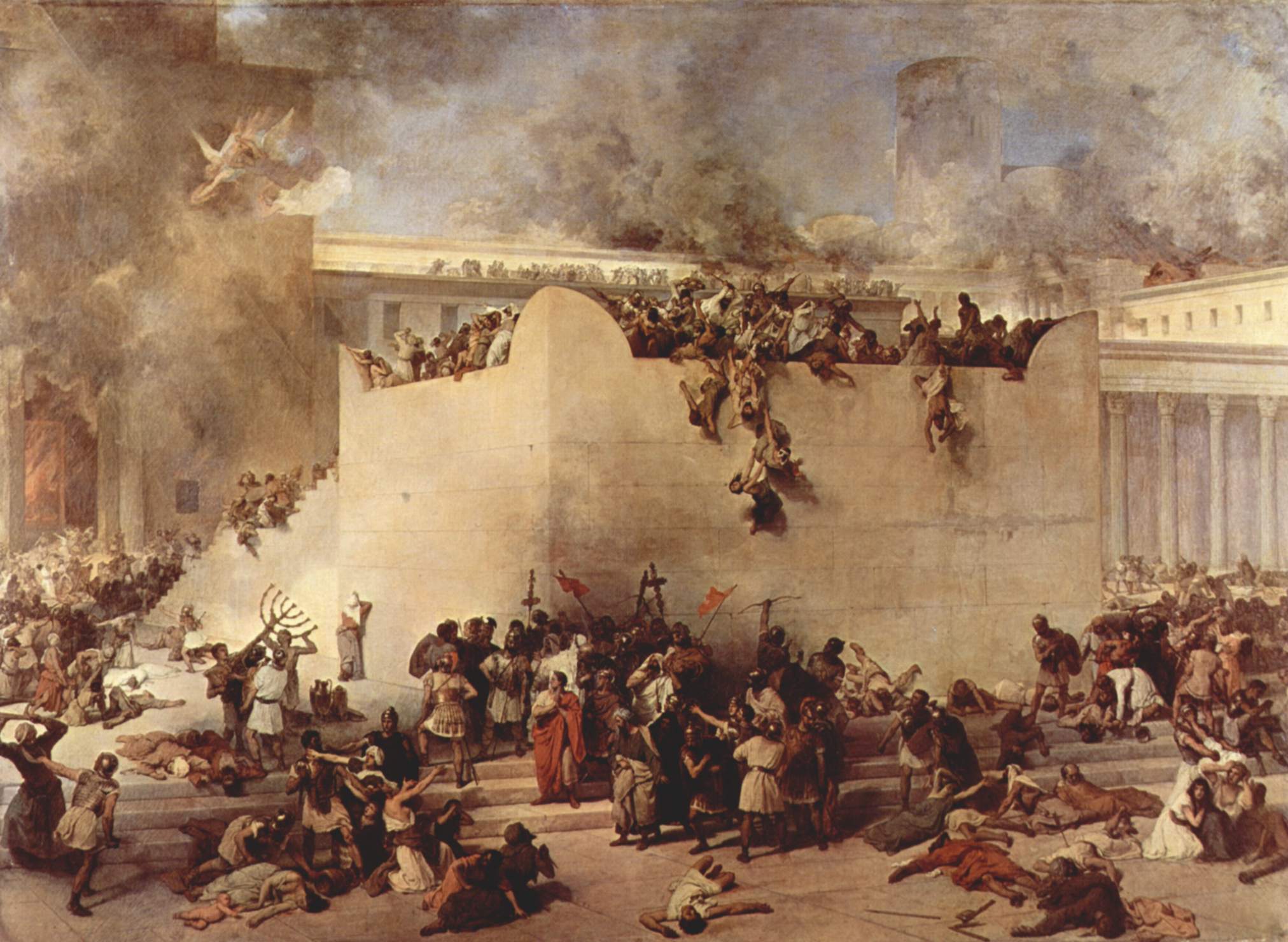
Revelation 20:14 says, "Then DEATH and SHEOL were thrown into the lake of fire." This apocalyptic imagery describes the violent end of the Old Covenant Law-based system, which was fully wiped out in 70 AD with the destruction of the Temple in Jerusalem.
The same literal fire that destroyed the Temple is the same fire in which death was destroyed, because death and the Law were always intertwined. That fire was a purging, a correction, pointing to mankind's redemption and the full arrival of the New Covenant.
Romans 11:32 says, "He has shut ALL up in unbelief to show mercy on ALL."
Once you understand this, you become free to engage with your true identity (spirit) as the false identity (ego) gradually releases its grip on your heart and mind.
As I like to say, "These things do not appear from out of the blue, but they appear from out of you."
_________________
So the modern evangelicals need to be reminded that ancient Jews adopted many "pagan" beliefs during their various captivities.
During the HUNDREDS OF YEARS they spent in the Assyrian, Babylonian, and Egyptian captivities, the Jewish people were exposed to many pagan mythologies, cosmologies, and ritual practices.
As a result, pagan motifs, archetypes, and symbolic structures began to blend with Jewish tradition ... especially in texts like the Book of Enoch, which draws heavily on Mesopotamian and Persian cosmology (e.g., the Watchers, the Nephilim, the cosmic hierarchy of angels and demons).
There are some biblical passages that warn about these distorted Jewish myths, especially those which were influenced by pagan mythology.
...
Titus 1:14: “They must stop listening to Jewish myths and the commands of people who have turned away from the truth.”
1 Timothy 4:7: “But have nothing to do with old folklore and silly myths.”
...____________________
Then there's the Book of Enoch, an ancient Jewish text (not in most Bibles today, but very influential back then).
NONE of the pagan beliefs espoused in the Book of Enoch were truly written through "divine inspiration" or canonized as scripture ...Yet, many of these pagan concepts (especially the myth of fallen angels mating with women) found their way into the Latin Vulgate, distorting the original harmonic intent of the Hebrew and Greek texts.
Let's consider Enoch 15:8 which says : 'And now, the giants (nephilim), who are produced from the spirits and flesh, shall be called "EVIL SPIRITS" upon the earth, and the EARTH SHALL BE THEIR DWELLING.'
This passage led many early Bible scholars to reinterpret 'sons of Elohim' (divine beings or rulers) as 'fallen angels' or 'demons' ... thus ostensibly reinforcing the pagan folklore of celestial-human unions, even though it never happened.
The stories in the book of Enoch ... of 'Watchers' - angels who came to Earth, mixed with humans, and taught forbidden things. This really cemented the idea of angels rebelling and falling.
While the canonical Bible doesn't explicitly state that "demons are fallen angels," Enoch's narrative provided a detailed cosmology that filled in the gaps and shaped later interpretations.
Here's how it did that :
The Book of Enoch describes a group of angels called Watchers who descended to Earth. These Watchers took human wives, taught forbidden knowledge (like metallurgy, cosmetics, and astrology), and fathered giant offspring known as the Nephilim.
This act was seen as a rebellion against God's order, a transgression of their "first estate" (as mentioned in Jude 1:6).
In Enoch's account, God sends Archangels (like Michael, Gabriel, Raphael, and Uriel) to bind the Watchers in chains and cast them into a place of darkness and torment.
This binding is described as a prelude to a final judgment, where they will be thrown into a "lake of fire."
The spirits of the Nephilim (the giant offspring of the Watchers and human women) are said to become the demons that roam the Earth, causing corruption and suffering.
Thus, Enoch provides a clear lineage: fallen angels → Nephilim → demons.
Although the Book of Enoch is not part of the canonical Bible for most Christian denominations, it was widely read and highly influential in early Christian communities.
Early Church Fathers like Origen, Augustine, and Gregory the Great drew upon Enoch's cosmology to construct their understanding of a heavenly rebellion, the fall of Lucifer, and the origin of demons.
This synthesis, combined with symbolic readings of Isaiah 14 (the fall of the "morning star") and Revelation 12 (the dragon sweeping a third of the "stars" from heaven), solidified the idea that demons are fallen angels who followed Lucifer in his rebellion.
What's disturbing is that the narrative in the Book of Enoch became a foundational text for early Christian doctrine, shaping the way many have understood the nature of evil and spiritual opposition.
Instead of insisting on a literal interpretation of history ... I see it as a mirror describing the descension into the lower 3D realm of EGO.
The Watchers represent aspects of consciousness that descend into form—like inspiration, intuition, or even ego.
The Nephilim and their spirits (demons) are the distorted reflections that arise when consciousness loses coherence. They are not external entities, but internal patterns of fear, pride, addiction, or confusion.
Their descent is the process of spirit becoming entangled in matter, or awareness becoming identified with the body and its desires.
The forbidden knowledge they teach is not evil in itself, but becomes distortion when misused—like power without wisdom, or technology without heart.
So, the Book of Enoch can be read as a map of distortion:
- It shows how consciousness can lose its way when it forgets its origin.
- It describes the consequences of mixing higher awareness with lower motives.
- And it reveals how the 'demons' we encounter are often the echoes of our own fragmentation.
But it also offers a path back :
- The binding of the Watchers and the judgment of the Nephilim can be seen as the integration of shadow.
- When you recognize these patterns within yourself, you begin to bind them - not by fighting, but by understanding and transforming them.
- The 'lake of fire' is not punishment, but a purging - a crucible where distortion is melted down and coherence is restored.
Please understand, I don't see the Book of Enoch as “evil” just because contains some pagan elements ... but it does become problematic when it's stories are treated as literal history rather than symbolic or metaphorical.
Just like the Latin Vulgate’s distortion of turning “nothing” into “demons” is problematic. The danger is not in the mythology itself, but in treating symbolic and metaphoric distortion as literal truth.
Some of you are probably thinking HOW CAN YOU DENY THE EXISTENCE OF THE NEPHILIM - ESPECIALLY WHEN KING DAVID FOUGHT A GIANT CALLED GOLIATH ?
Well ... I'll give it to you like this ...
In 1 Samuel 17, David defeats Goliath, a Philistine warrior described as being "six cubits and a span" ... roughly 9 feet 9 inches tall.
However, some ancient manuscripts (like the Septuagint and Dead Sea Scrolls) describe Goliath as "four cubits and a span"... closer to 6 feet 9 inches, which is tall but within human range.
This suggests the 9'9" figure may be another scribal exaggeration.
Seeing as how the Latin church has a history of distorting the biblical text, I TEND TO BELIEVE THE GREEK TEXT ... AND DEAD SEA SCROLLS.
Finally, Revelation 12 describes a great dragon sweeping a third of the 'stars' from heaven. Because of the other stories, people started to interpret these 'stars' as the angels who followed Lucifer in his rebellion.
So, the idea of 'demons as fallen angels' is a symbolic story that emerged from combining these texts and early theological interpretations. It's a way of explaining the origin of evil and spiritual opposition.
____________